
Two routes, one name
How pay by phone casino deposits actually work in the UK
Two arrangements are sold under the same name. One charges the amount to a mobile account, so a telecoms company moves the money. The other uses the handset only to present a card, so a card network moves it exactly as it would in a shop. What follows is pay by phone casino deposits explained by route rather than by brand, because the rules deciding who may handle a gambling payment treat those two cases very differently.
What "pay by phone casino" means in practice
The phrase describes a device, not a payment method. That is the whole difficulty. A player who deposits using a phone might have charged the amount to a mobile account, or might have used a card stored in a phone wallet, and the cashier page that offered both will often have used the same four words for each. Anyone asking how pay by phone casino deposits actually work is therefore asking two separate questions without realising it.
The distinction is not cosmetic. The two routes involve different companies, different contractual chains and different bodies of regulation. One of them is an ordinary card payment wearing a phone-shaped hat. The other reaches the gambling business through the mobile network and its billing partners, and that route has to satisfy a licence condition written in terms of what counts as a payment service.
Most published explanations of pay by phone casino deposits describe the button rather than the plumbing. They say the deposit is quick, that no card details are entered, and that limits are low. All three statements can be true of the carrier route and only one of them is true of the card route, which is how a reader ends up with a confident and incorrect picture of what happened to their money.
Two routes, and why the difference matters
Take the carrier route first. The player asks for a deposit, the amount appears on a mobile account, and the network settles with the gambling business through one or more intermediaries. No card is involved at any point. The money starts inside a telecoms billing relationship and has to get out of it.
Now the card route. The player authorises a card already held in a phone wallet. A card network carries the transaction, an issuer approves it, and an acquirer settles it. This is the same sequence as tapping the same phone at a supermarket till, and the rules that apply to it are the rules that apply to any card payment.
Both get called pay by phone casino deposits on the way in. Only the first raises a question about whether a payment service is being provided at all, and that question is not a technicality about paperwork. It decides whether a licensed gambling business is permitted to accept the deposit in the first place.
The rest of this page follows the harder route. Pay by phone casino deposits explained from the rules outward is really an account of that one route, because the card route needs no explanation beyond the sentence above.
Telling the two routes apart at the cashier
Nothing on a cashier page reliably announces which route is on offer, but the mechanics leak through in a few places and you can usually read them off the screen. If the deposit asks you to select or authorise a card, whether that is typed digits or a wallet confirmed with a fingerprint or a face, it is the card route. A card is being presented and the phone is the presentation method.
If instead the deposit is confirmed against a mobile number, with no card selected at any stage, it is the carrier route. Two further signs point the same way. The amount will later appear on a mobile bill or reduce pay-as-you-go credit rather than showing on a card statement, and the maximum single deposit offered will be low.
That ceiling is the most reliable single tell. A route capped at £40 for one transaction is a route built inside the exclusion's limits, because those are the limits the exclusion sets.
The distinction survives the branding. Two cashiers can present the same wording, the same icon and the same promise of a deposit in seconds while sending the money along entirely different chains, and the wording is not what decides which rules apply.
Why a gambling deposit is not covered by the exclusion
The carrier route generally rests on something called the Electronic Communications Exclusion. It sits in Schedule 1, Part 2 of the Payment Services Regulations 2017, at paragraph 2(l), and it allows a mobile network to collect payment for certain things without that collection counting as a regulated payment service.
The usual argument against using it for gambling is a structural one about which part of the schedule the licence condition points at. That argument works, and it appears further down this page. But there is a prior objection that is harder to answer and it is about subject matter.
PERG 15.5 Q41A sets out what the exclusion actually covers. Two categories: the purchase of digital content and voice-based services, with music, digital downloads and premium rate services given as the examples; and transactions performed from or via an electronic device for donations to charity, SMS donations being the example given, or for the purchase of tickets. The same guidance then states in terms that the exclusion does not apply to the purchase of physical goods.
Hold a gambling deposit against that list. It is not digital content. It is not a voice-based service. It is not a charity donation and it is not a ticket. It is also not a physical good, which matters only in that the physical-goods sentence shows the categories are meant to be read as a closed set rather than as illustrations of a general permission.
So the exclusion does not reach a casino deposit, and it never did. Nothing about caps, chains or schedule structure is needed to get there.
The transaction is the wrong kind of transaction.
This is the part most competing pages miss, and the reason they miss it is understandable: the structural argument is easier to summarise and it sounds more technical, so it travels better. The subject-matter point requires reading Q41A itself. Note the letter. Q41 and Q42 are both marked "[deleted]" in the Handbook, so a citation to Q41 is a citation to text that is no longer there, and that particular slip is common enough to be a useful signal about where a page got its research.
Where the licence condition sits, and where the exclusion sits
The second argument is about geography inside one document. Licence condition 5.1.2 requires that a payment method used by a licensed gambling business involves a payment service as defined in Schedule 1, Part 1 of the 2017 Regulations, provided by a payment service provider within the meaning of regulation 2. The condition also covers equivalent requirements in any instrument amending or superseding those regulations, so it does not go stale when the regulations move.
Schedule 1 has two parts. Part 1 is headed "Payment services". Part 2 is headed "Activities which do not constitute payment services".
The Electronic Communications Exclusion is in Part 2.
That is the entire argument. A condition demanding a Part 1 service cannot be satisfied by an activity that Part 2 defines as not being one. The two are not in tension and no interpretation is required to reconcile them, because the schedule's own headings do the work.
It is worth being careful about what the condition does not say. It does not say the provider must be authorised. It does not say the provider must be registered. It sets a definitional test: does this provider meet the regulation 2 meaning of a payment service provider, and is this a Part 1 service. The Commission's own summary prose has been known to describe it as requiring registration with the FCA, and repeating that overstates the condition. The distinction matters because a definitional test and an authorisation requirement fail in different ways and are cured by different things.
There is also a date that gets misused here. Condition 5.1.2 shows an effective date of 31 January 2024, and that has been read as the moment the requirement arrived. It was not. The amendment updated the citation from the 2009 Regulations to the 2017 Regulations, and the Commission's consultation response describes it as having no material impact on licensees' obligations. The substantive requirement predates it by years under the older equivalent. This was never permitted; it simply went unexamined for a long time.
How the exclusion passes down the payment chain
A carrier-billed deposit does not travel directly from a mobile network to a gambling business. There is at least one intermediary, usually an aggregator holding the commercial relationships on both sides, and the exclusion has to account for a chain rather than a single payer.
PERG 15.5 Q41B handles that. Where the party at the head of the chain benefits from the exclusion, providers further down benefit from it too in respect of payment services resulting from it. The protection flows downhill. It is conditional, though, and the condition is the important part: it holds only while the party at the head of the chain continues to satisfy the exclusion's requirements.
When that stops being true, the intermediaries do not simply revert to a neutral position. The guidance says they will need to consider what action they need to take to avoid breaching the regulations, and it offers becoming authorised as an example of such action. The protection they were relying on was never theirs. It was borrowed from upstream, and it can be withdrawn by someone else's conduct.
The guidance adds a detail that sharpens this considerably. A terminating operator, unlike an originating one, cannot directly control the spend against the caps. The party best placed to see an individual subscriber approaching £240 in a month is the one closest to the subscriber. The parties whose regulatory position depends on that ceiling being respected may be several steps away with no direct visibility of it.
That is the actual mechanism behind the distinction between the two routes, and it is why the distinction is structural rather than a matter of which provider a gambling business happens to prefer. The card route carries no equivalent dependency. Nobody in a card chain is relying on a condition satisfied by a different company to establish that a payment service is being provided.
For anyone depositing, the consequence of a borrowed permission is that the route is only ever as stable as the arrangement above it. A card deposit that worked yesterday works today because the card network, the issuer and the acquirer are each doing something that is a payment service in its own right. A carrier-billed deposit works because a party further up the chain satisfies conditions the player cannot see, has no relationship with, and would have no way of checking. That is not a criticism of anyone in the chain. It is a description of where the permission comes from, and permissions that come from somewhere else can be withdrawn from somewhere else.
Carrier billing: charging the deposit to a mobile account
Carrier billing is the route the phrase originally described, and how pay by phone casino deposits actually work on it is easy to state and easy to mis-state. The amount goes onto a mobile account, against a monthly bill for a contract customer or against credit for a pay-as-you-go one, and no card details are entered anywhere. For a certain kind of purchase it is genuinely elegant: a single tap, no card, no account setup, settled by a company the customer already pays every month.
That elegance is why carrier billing is widespread for the purchases the exclusion was written around. Buying digital content, paying for a premium rate service, donating by SMS. In those cases the exclusion applies on its own terms and the arrangement works exactly as designed.
A gambling deposit is a different transaction wearing the same interface. The tap looks identical, the receipt looks identical, and the underlying question of whether anyone in the chain is providing a Part 1 payment service has a different answer. Carrier billing is not a disreputable mechanism being misused; it is a well-designed mechanism whose design brief did not include this.
This is also where the two names most often get conflated. Boku Account Services UK Ltd appears on a great many pages as a synonym for carrier billing, and it is not one. That firm holds FRN 900030 as an Authorised Electronic Money Institution under the Electronic Money Regulations 2011, effective 24 May 2018, with payment-initiation and account-information permissions under the 2017 Regulations, and it is registered at Companies House under number 06169107. A firm with e-money authorisation is in a different position from an arrangement resting on an exclusion for activities that are defined as not being payment services. Treating the brand and the route as one thing loses precisely the distinction that decides the outcome.
The practical consequence for a UK player is narrow and easy to state. Where a deposit is charged to a mobile account, the arrangement behind it has to answer a question that a card deposit never raises.
The card route: the handset as a payment terminal
The other route is the one most people mean when they say they paid with their phone, and it is the less interesting of the two by a wide margin. A card lives in a phone wallet. The player authorises it with a fingerprint, a face or a passcode. A card network carries the transaction to an issuer, which approves or declines it, and an acquirer settles it with the merchant.
Every participant in that sequence is doing something Schedule 1, Part 1 describes. The licence condition is satisfied without anyone reaching for an exclusion, because the activity is a payment service in the ordinary sense and the providers are payment service providers in the regulation 2 sense. There is no argument to make.
The handset contributes tokenisation and device authentication, which are real security improvements over reading digits off a piece of plastic. Neither changes the regulatory character of the payment. A pay by phone casino deposit made this way is a card deposit, and a tokenised card is a card.
One genuine restriction applies here and it has nothing to do with phones. Licence condition 6.1.2 has prohibited gambling on credit cards since 14 April 2020, and the wording reaches beyond the card itself to capture payment through a money service business, which brings in e-wallets funded by a credit card. Non-remote society lottery and external lottery manager licences sit outside that prohibition. So a debit card in a phone wallet is unremarkable, and a credit card in the same wallet is barred by a condition that would bar it just as firmly in physical form.
Deposit limits for UK players: the £40 and £240 caps
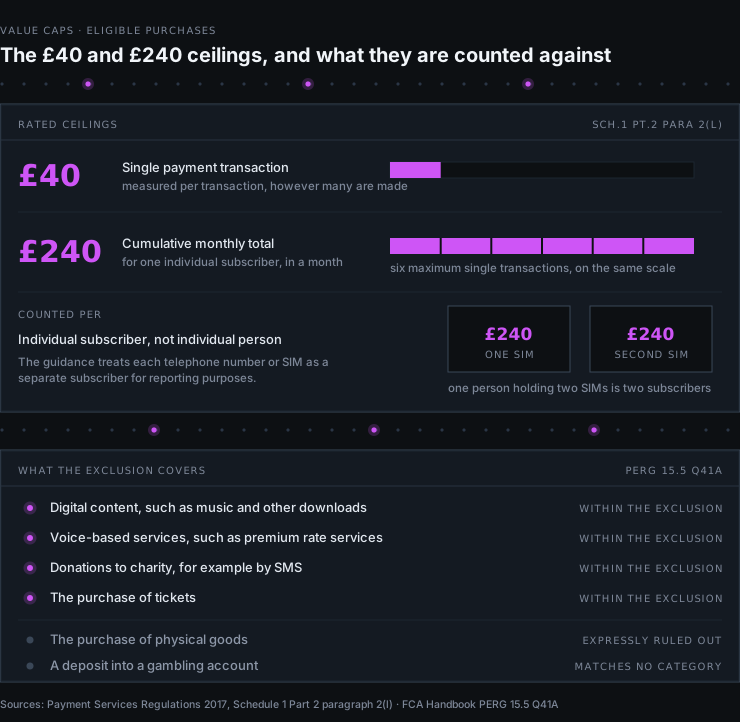
The exclusion carries value caps, and they are quoted often enough to have acquired a life of their own. Schedule 1, Part 2, paragraph 2(l) states them directly: the value of any single payment transaction must not exceed £40, and the cumulative value of payment transactions for an individual subscriber in a month must not exceed £240. PERG 15.5 repeats them.
What the exclusion requires
Sch.1 Pt.2 para 2(l)- Single payment
- Must not exceed £40 stated in the schedule
- Monthly total
- Must not exceed £240 cumulative stated in the schedule
- Counted per
- Individual subscriber, which the guidance treats as each telephone number or SIM stated in the guidance
- Eligible purchases
- Digital content and voice-based services, charity donations, tickets. Physical goods are ruled out expressly. stated in the guidance
- Gambling deposit
- Matches none of the eligible categories not an eligible purchase
The phrase to look at is "individual subscriber". The guidance treats each telephone number or SIM as a separate subscriber for reporting purposes, which means the ceiling attaches to the SIM and not to the person holding it. Someone with a work phone and a personal phone is two subscribers. Someone with a dual-SIM handset is two subscribers while holding one device.
Check a deposit against the caps
Enter a transaction amount and, if the same SIM has already deposited this month, that running total — the £240 ceiling is cumulative per subscriber, not a fresh allowance on every deposit.
Result
Sch.1 Pt.2 para 2(l)- This transaction
- £0.00 entered within the £40 single-transaction cap
- Month to date, this SIM
- £0.00 entered within the £240 monthly cap
This is stated incorrectly almost everywhere it is stated at all. The common formulation is that the limit is £240 per month per person or per account, which describes a tighter ceiling than the rules impose and gets the unit of measurement wrong. It is a small error with a real consequence, because a cap that attaches to a SIM behaves differently from one that attaches to an individual the moment anyone holds more than one.
Worth keeping in proportion, though. For a gambling deposit the caps are the least of it. The exclusion has already failed on subject matter before any figure is reached, so a deposit that comfortably clears both thresholds is no better placed than one that breaches them. The caps matter to the businesses in the chain, whose position depends on them being respected, rather than to the eligibility of the transaction.
Which leaves one question this page cannot answer. The exclusion has to be relied on by somebody at the head of the chain, and the FCA places the notification duty on the network operator rather than on an intermediary. That points at the mobile networks rather than at the aggregators whose names appear on cashier pages. But the published notification information was not obtained while this page was written, and identifying a firm from the shape of the chain rather than from a record would be a guess about a real business dressed up as a finding. So the party at the head of this particular chain is left unnamed here, which is unsatisfying and preferable to the alternative.
That unanswered identity does not alter the transaction test. The subject matter fails before the chain is named: a gambling deposit is not digital content, a voice-based service, a charity donation or a ticket. The Part 1 and Part 2 split then reaches the same answer from the licence condition. Naming the network would add a fact about the commercial chain, but it would not turn the deposit into an eligible purchase or the exclusion into a payment service.
For a player, the useful evidence remains on the transaction itself. A request to authorise a stored debit card points to the ordinary card rail. A request tied to a mobile number, followed by a charge on a bill or a reduction in prepaid credit, points to carrier billing. The words on the button can be identical in both cases, so the confirmation step and the eventual statement entry tell the story more reliably than the cashier label.
The withdrawal side exposes the difference once more. A card or account-based wallet can often receive money back because an account exists at the end of the route. A mobile-account charge creates no equivalent destination for a casino payout. Choosing carrier billing therefore also means arranging a second method for withdrawals, even if the deposit screen says nothing about that second route.
Questions about pay by phone casino deposits
Reference
Does licence condition 5.1.2 say a provider must be FCA-authorised?
No, and this is worth being precise about because it is widely paraphrased that way. The condition requires the payment method to involve a payment service as defined in Schedule 1, Part 1, provided by a payment service provider within the meaning of regulation 2. That is a definitional test. The condition text uses neither "authorised" nor "registered", even though the regulator's own summary prose sometimes does.
Did the rules change on 31 January 2024?
The wording did. The substance did not. The amendment updated the condition to cite the Payment Services Regulations 2017 in place of the 2009 Regulations, and the Gambling Commission's consultation response records it as having no material impact on licensees' obligations. The underlying requirement long predates that date under the older equivalent.
Are the £40 and £240 caps per person?
No. They are per individual subscriber, and the guidance treats each telephone number or SIM as a separate subscriber. Someone holding two SIMs is two subscribers for this purpose. Almost every page that mentions these figures describes them as a per-person or per-account limit, which is a different and lower ceiling than the rules actually set.
What happens to the aggregators if the network at the head of the chain fails a condition?
They lose the protection they were relying on. PERG 15.5 Q41B extends the exclusion downstream only while the party at the head of the chain satisfies its conditions. When that stops being true, intermediaries have to consider what they need to do to avoid breaching the regulations, which the guidance says may include becoming authorised.
Can a terminating operator control whether the caps are breached?
Not directly, and the guidance acknowledges the asymmetry. An originating operator sits where the spend happens and can see it accumulate. A terminating operator further along the chain does not have the same visibility, yet the exclusion it relies on depends on caps being respected upstream.
Is Boku the same thing as carrier billing?
They are not interchangeable. Boku Account Services UK Ltd is a real firm with its own regulatory standing: it holds FRN 900030 as an Authorised Electronic Money Institution under the Electronic Money Regulations 2011, effective 24 May 2018, with payment-initiation and account-information permissions under the 2017 Regulations. Carrier billing describes a route. A firm with e-money authorisation is not relying on an exclusion for activities that are not payment services.
Does using a phone to pay by card count as pay by phone?
It is marketed that way, and it is the route most people actually encounter. A card held in a phone wallet is still a card payment: the same card network, the same issuer, the same rules that apply in a shop. The handset replaces the plastic and changes nothing about the payment service underneath.
Why can a card be used for a deposit when carrier billing is difficult?
Because a card payment is squarely a payment service under Schedule 1, Part 1, made by providers who are unambiguously payment service providers. It satisfies the licence condition without needing an exclusion at all. The carrier route has to argue its way in; the card route never has to make the argument.
Can a credit card be used for gambling in the UK?
No. Licence condition 6.1.2 has prohibited it since 14 April 2020. The wording reaches further than the plastic itself: it captures payment through a money service business, which brings e-wallets funded by credit card within scope. Non-remote society lottery and external lottery manager licences sit outside that ban.
Is there a version of carrier billing that would satisfy the licence condition?
In principle the obstacle is the exclusion, not the handset. A provider in the chain that is itself a payment service provider within the regulation 2 meaning, offering a Schedule 1 Part 1 service, is not relying on the exclusion and so is not caught by this particular problem. The difficulty is specific to arrangements built on an exclusion for activities that are defined as not being payment services.
Which question in PERG covers this, and why does the number matter?
Q41A, in PERG 15.5. The number matters because Q41 and Q42 are both marked "[deleted]", so a citation to Q41 points at withdrawn text. Anything quoting the bare number is either working from an old copy or from another page that did.
Does any of this mean a particular operator has broken a rule?
No, and nothing here should be read that way. Everything above concerns the scope of the statutory definitions and which activities fall inside them. Whether any named business complies is a separate question that turns on facts about that business, and a published register status on a stated date is the only sound way to say anything about it.
Where can the primary sources be read directly?
Schedule 1 of the Payment Services Regulations 2017 is on legislation.gov.uk, with Part 1 and Part 2 side by side. PERG 15.5, including Q41A and Q41B, is in the FCA Handbook. Licence condition 5.1.2 is published by the Gambling Commission. All three are short enough to read in full.
How can a player tell whether a phone deposit uses carrier billing or a card?
A card route asks the player to choose or authorise a stored card, often with a fingerprint, face or passcode. Carrier billing confirms against a mobile number without selecting a card, and the amount later appears on the bill or reduces pay-as-you-go credit. The cashier label alone does not settle which route is underneath.
Can a carrier-billed deposit be withdrawn to the same phone account?
No return path is described for that route. The charge travels onto a mobile account for collection; it does not create an account the casino can credit in reverse. A withdrawal therefore needs a separate method, unlike a card or wallet route that may support both directions.